REVIEW ARTICLE |
https://doi.org/10.5005/jihr-11055-0016 |
Epstein–Barr Virus: A Comprehensive Review
1Department of Microbiology, Smt SS Patel Nootan Science and Commerce College, Visnagar, Gujarat, India
2Department of Microbiology, Narsinhbhai Patel Dental College and Hospital, Sankalchand Patel University, Visnagar, Gujarat, India
Corresponding Author: Vaishnavi Patel, Department of Microbiology, Narsinhbhai Patel Dental College and Hospital, Sankalchand Patel University, Visnagar, Gujarat, India, Phone: +91 9313879008, e-mail: [email protected]
Received: 29 December 2025; Accepted: 06 February 2026; Published on: 30 April 2026
ABSTRACT
The Epstein–Barr virus (EBV) is a common virus that infects most people. In fact, >90% of adults around the world have the EBV. The EBV stays in people's bodies for their lives, mostly in certain blood cells and skin cells.
Primary infection with the EBV is usually asymptomatic; people usually do not experience any symptoms. They may develop a disease called infectious mononucleosis. EBV is important to consider because it has been linked to several types of cancer. The EBV has been linked to carcinoma, Hodgkin's lymphoma, and Burkitt's lymphoma.
Increasing evidence indicates that EBV is also associated with selected head and neck cancers. The virus contributes to disease development through its oncogenic potential and its involvement in multiple pathological conditions.
The EBV is linked to cancer in the head and neck area. This happens because of the virus's genes, like EBNA1 and LMP1, which are made by the EBV. These genes from EBV help the cancer cells grow and survive. They do this by making the cells' genetic material unstable, by hiding from the immune system, and by making the cells grow and die in an abnormal way. EBV deoxyribonucleic acid (DNA) has been found in types of cancer such as nasopharyngeal, hypopharyngeal, and oral squamous cell carcinomas. Sometimes, when the EBV and the human papillomavirus are both present, the cancer can become more serious. Studies have shown that the EBV is found more often in people with laryngeal carcinoma than in people without the EBV.
Scientists have found that some cancers of the head and neck have problems with their chromosomes. These problems occur in people who have the EBV. EBV is linked to cancers that have issues with chromosome 11. This means that EBV might be causing the chromosomes to become unstable. This is what genomic studies have shown about EBV-associated head and neck cancers.
This review is about the EBV virus and how it affects people who have head and neck cancer. It looks at how EBV spreads and what happens inside the body when someone has it. The review also discusses the importance of EBV in head and neck cancer and how markers can be used to diagnose it. Additionally, it discusses ways to treat EBV, such as using EBV-targeted immunotherapy and developing vaccines to fight the EBV virus.
Keywords: Biomarkers, Epstein–Barr virus, Head and neck cancer, Nasopharyngeal carcinoma, Viral oncology
How to cite this article: Patel RS, Patel VM. Epstein–Barr Virus: A Comprehensive Review. J Integr Health Res 2025;2(2):55–57.
Source of support: Nil
Conflict of interest: None
HISTORY AND INTRODUCTION
The Epstein–Barr virus (EBV) was discovered in 1964 by Epstein et al.1 Subsequent studies demonstrated the association of EBV with infectious mononucleosis and its ability to immortalize B lymphocytes.2 These discoveries established EBV as a human oncogenic virus.
Today, the EBV is recognized for its role in causing certain types of cancer. These include carcinoma, Hodgkin's lymphoma, Burkitt's lymphoma, and specific gastric carcinomas.3,4 EBV is also linked to some head and neck cancers. It contributes to cancers of the nasopharynx, larynx, and oropharynx.5–7 The virus remains hidden inside host cells for a period, which helps it avoid detection by the immune system. Additionally, the virus can lead to cancer because of proteins like EBNA1 and LMP1. These proteins are part of the virus and play a significant role in this process.4
ROLE OF EPSTEIN−BARR VIRUS IN DISEASE
Epstein–Barr virus is strongly associated with multiple malignancies, including Burkitt's lymphoma, Hodgkin's lymphoma, nasopharyngeal carcinoma, and EBV-associated gastric carcinoma.3,4,11
The EBV infection is linked to some health problems in which the body's defense system attacks itself. This includes systemic sclerosis, lupus erythematosus, rheumatoid arthritis, and Sjögren's syndrome.12–14 EBV infection has been associated with these conditions.
Mucocutaneous and inflammatory conditions are conditions that affect the skin and cause inflammation. The EBV is involved in many of these conditions. For example, the EBV is implicated in hairy leukoplakia, which is a condition that affects the mouth. The EBV is also implicated in multiform Gianotti–Crosti syndrome and lymphomatoid granulomatosis.15,16 These are all conditions with which the EBV is associated.
Emerging evidence suggests a possible association between EBV and α-synuclein-related neurodegenerative disorders, such as Parkinson's disease and dementia with Lewy bodies; however, this relationship remains controversial.17
The EBV is a problem worldwide. It is thought that the EBV contributes to around 2,00,000 cases of cancer every year.18
As shown in Figure 1, the virus infects immune system B cells and epithelial cells. After the initial lytic phase is contained, EBV remains latent in a person's B cells for life.
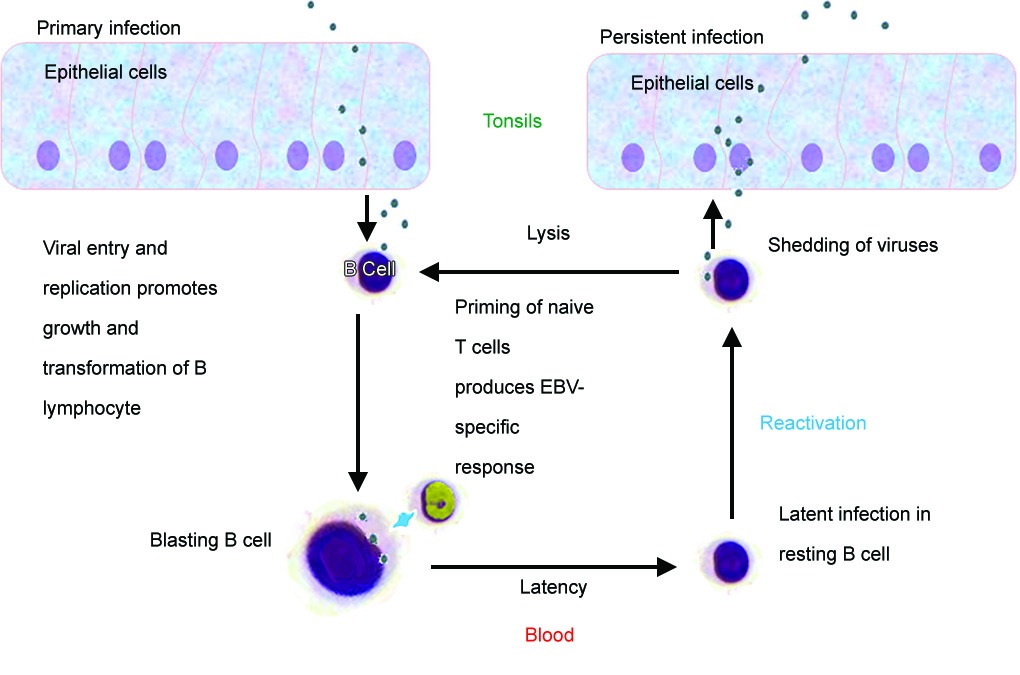
Fig. 1: The EBV infection cycle. Primary infection occurs in the oropharyngeal epithelium, leading to B-cell infection and transformation. EBV establishes latency in resting memory B cells and undergoes periodic reactivation in tonsillar tissue, resulting in viral replication and shedding, enabling lifelong persistence and transmission21
TROPISM
The EBV selectively infects B lymphocytes and epithelial cells.19 Fusion with B-cell membranes is facilitated by a tripartite glycoprotein complex (gHgL-gp42), whereas entry into epithelial cells involves a bipartite version (gHgL).20
For the B cell to get infected, the EBV uses a protein called gp350 that binds to the CD21 receptor on the B cell. Then another protein called gp42 interacts with major histocompatibility complex (MHC) class II molecules.21 The EBV can also use CD35 to enter the B cell.22 When EBV infects cells, it uses a different protein called BMRF-2 and a special way of joining cells together called integrin-mediated fusion mechanisms.10
DIAGNOSTIC AND BIOMARKER APPLICATIONS OF EBV IN HEAD AND NECK CANCERS
The way to be sure that EBV is in tumor tissues is to do an in situ hybridization test to find EBV-encoded ribonucleic acid (RNA).23 This test is the way to confirm that the EBV is really there.
We also use a test called PCR to find EBV deoxyribonucleic acid (DNA) in tissue samples that doctors take from people, in saliva, and in plasma.24
Circulating EBV DNA is really useful for finding out if someone has a problem. It can also help figure out what is going to happen and how well the treatment is working for people with nasopharyngeal carcinoma. When there is a lot of EBV DNA in the blood, it usually means the disease is very bad. The person will not do well. Circulating EBV DNA is a way to check on people without hurting them. High levels of EBV DNA are often a sign of disease, and this can lead to poorer outcomes for people with nasopharyngeal carcinoma and circulating EBV DNA.25
CONCLUSION
The EBV is a problem for people because it is everywhere and stays in our bodies forever. It also causes a lot of diseases, including some cancers in the head and neck. We have learned a lot about viruses, but we still do not know exactly how the EBV causes some of these head and neck cancers, especially the ones that are not in the nose area.3–7 We really need an EBV vaccine that is approved and also some medicine that can fight the EBV virus. The fact that we do not have an approved EBV vaccine and some medicine that can fight the EBV virus is a problem.18
Future studies should focus on making EBV vaccines that can prevent the disease, EBV treatments that use the system, and ways to detect the EBV virus early. The EBV vaccine is very important. We should also have some way to monitor the EBV disease. The EBV vaccine and the EBV treatments are necessary to help people with the EBV virus.
ORCID
Rishita S Patel https://orcid.org/0009-0009-2506-0791
REFERENCES
1. Epstein MA, Achong BG, Barr YM. Virus particles in cultured lymphoblasts from Burkitt's lymphoma. Lancet 1964;1(7335):702–703. DOI: 10.1016/s0140-6736(64)91524-7
2. Henle W, Henle G. Epidemiologic aspects of Epstein–Barr virus (EBV)—associated diseases. Ann NY Acad Sci 1980;354:326–331. DOI: 10.1111/j.1749-6632.1980.tb27975.x
3. Prabhu SR, Wilson DF. Evidence of Epstein–Barr virus association with head and neck cancers: a review. J Can Dent Assoc 2016;82:g2. PMID: 26856803.
4. Fernandes Q, Merhi M, Raza A, et al. Role of Epstein–Barr virus in the pathogenesis of head and neck cancers and its potential as an immunotherapeutic target. Front Oncol 2018;8:257. DOI: 10.3389/fonc.2018.00257
5. Goldenberg D, Golz A, Netzer A, et al. Epstein–Barr virus and cancers of the head and neck. Am J Otolaryngol 2001;22(3):197–205. DOI: 10.1053/ajot.2001.23429
6. Al-Thawadi H, Gupta I, Jabeen A, et al. Co-presence of human papillomaviruses and Epstein–Barr virus is linked with advanced tumor stage: a tissue microarray study in head and neck cancer patients. Cancer Cell Int 2020;20:361. DOI: 10.1186/s12935-020-01348-y
7. de Lima MAP, Silva ADL, do Nascimento Filho ACS, et al. Epstein–Barr virus–associated carcinoma of the larynx: a systematic review with meta-analysis. Pathogens 2021;10(11):1429. DOI: 10.3390/pathogens10111429
8. Young LS, Rickinson AB. Epstein–Barr virus: 40 years on. Nat Rev Cancer 2004;4(10):757–768. DOI: 10.1038/nrc1452
9. Maeda E, Akahane M, Kiryu S, et al. Spectrum of Epstein–Barr virus–related diseases: a pictorial review. Jpn J Radiol 2009;27(1):4–19. DOI: 10.1007/s11604-008-0291-2
10. Shannon-Lowe C, Rowe M. Epstein–Barr virus entry; kissing and conjugation. Curr Opin Virol 2014;4:78–84. DOI: 10.1016/j.coviro.2013.12.001
11. Gandhi MK, Tellam JT, Khanna R. Epstein–Barr virus-associated Hodgkin's lymphoma. Br J Haematol 2004;125(3):267–281. DOI: 10.1111/j.1365-2141.2004.04902.x
12. Ascherio A, Munger KL. Epstein–Barr virus infection and multiple sclerosis: a review. J Neuroimmune Pharmacol 2010;5(3):271–277. DOI: 10.1007/s11481-010-9201-3
13. Pender MP. CD8+ T-cell deficiency, Epstein–Barr virus infection, vitamin D deficiency, and steps to autoimmunity: a unifying hypothesis. Autoimmune Dis 2012;2012:189096. DOI: 10.1155/2012/189096
14. Dreyfus DH. Autoimmune disease: a role for new anti-viral therapies? Autoimmun Rev 2011;11(2):88–97. DOI: 10.1016/j.autrev.2011.08.005
15. Cherry-Peppers G, Daniels CO, Meeks V, et al. Oral manifestations in the era of HAART. J Natl Med Assoc 2003;95(2 Suppl 2):21S–32S. PMID: 12656428.
16. Tagliavini E, Rossi G, Valli R, et al. Lymphomatoid granulomatosis: a practical review for pathologists dealing with this rare pulmonary lymphoproliferative process. Pathologica 2013;105(4):111–116. PMID: 24466760.
17. Woulfe J, Hoogendoorn H, Tarnopolsky M, et al. Monoclonal antibodies against Epstein–Barr virus cross-react with alpha-synuclein in human brain. Neurology 2000;55(9):1398–1401. DOI: 10.1212/wnl.55.9.1398
18. Khan G, Hashim MJ. Global burden of deaths from Epstein–Barr virus attributable malignancies 1990–2010. Infect Agents Cancer 2014;9(1):38. DOI: 10.1186/1750-9378-9-38
19. Wang X, Hutt-Fletcher LM. Epstein–Barr virus lacking glycoprotein gp42 can bind to B cells but is not able to infect. J Virol 1998;72(1):158–163. DOI: 10.1128/JVI.72.1.158-163.1998
20. Ogembo JG, Kannan L, Ghiran I, et al. Human complement receptor type 1/CD35 is an Epstein–Barr virus receptor. Cell Rep 2013;3(2):371–385. DOI: 10.1016/j.celrep.2013.01.023
21. Odumade OA, Hogquist KA, Balfour HH Jr. Progress and problems in understanding and managing primary Epstein–Barr virus infections. Clin Microbiol Rev 2011;24(1):193–209. DOI: 10.1128/CMR.00044-10
22. Dogan S, Hedberg ML, Ferris RL, et al. Human papillomavirus and Epstein–Barr virus in nasopharyngeal carcinoma in a low-incidence population. Head Neck 2014;36(4):511–516. DOI: 10.1002/hed.23318
23. Calderwood MA, Venkatesan K, Xing L, et al. Epstein–Barr virus and human protein interaction maps. Proc Natl Acad Sci USA 2007;104(18):7606–7611. DOI: 10.1073/pnas.0702332104
24. Pannone G, Zamparese R, Pace M, et al. The role of EBV in the pathogenesis of Burkitt's lymphoma: an Italian hospital based survey. Infect Agents Cancer 2014;9:34. DOI: 10.1186/1750-9378-9-34
25. Amon W, Farrell PJ. Reactivation of Epstein–Barr virus from latency. Rev Med Virol 2005;15(3):149–156. DOI: 10.1002/rmv.456
________________________
© The Author(s). 2025 Open Access. This article is distributed under the terms of the Creative Commons Attribution-NonCommercial 4.0 International License (https://creativecommons.org/licenses/by-nc/4.0/). This license permits non-commercial use, distribution, and reproduction in any medium, provided the original author and source are credited, a link to the license is included, and any changes are indicated.